|
Assorted
Dyno Runs
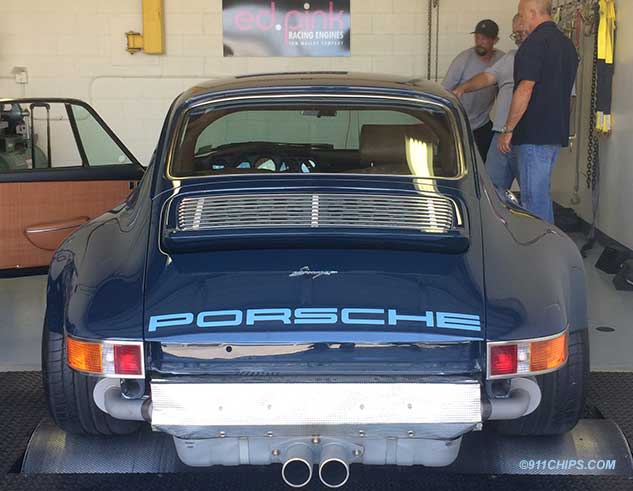
The
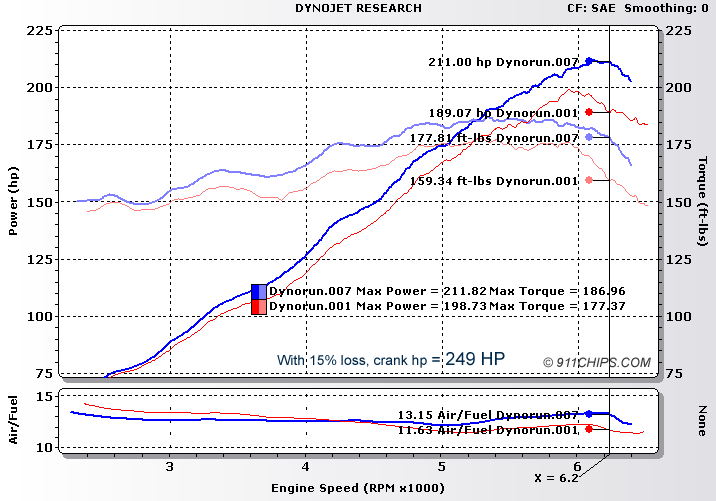
following runs are from an 88 Carrera 3.2 all stock
with a cat except with a sport muffler. The dyno
is a Dynojet 248h at Dynospot Racing in San Jose.
All figures displayed below are rear wheel hp numbers,
and must be divided by 0.85 for the corrected crank
hp values. The
two runs compare the stock chip in red vs. a 911Chips
performance chip in blue mated with a premuffler in place of the cat. The chip is
programmed for 91 octane California pump gas. Here
we see that with our performance chip mated with
the exhaust mods, the engine produces a maximum
of 211.8 rear wheel hp, or 249 at the flywheel corrected
for a 15% loss. Peak hp has extended from the factory
peak at 5900 to a new peak at 6200 rpm and 211 rear
wheel hp. At 6200 rpm, the car has gained 22 rear
wheel hp and 18 ft-lbs of torque, equivalent to
26 hp at the flywheel. You can actually feel the
seemingly nonstop hp rise past 6000 rpm to the rev
limit. Torque gain has increased an average of 10-12
ft-lbs throughout the mid and upper rpm band.
Compare
these power gains to those of other chip 'tuners'
as independently performed by Bruce Anderson here,
and you will see that our chips produce the most
hp under the curve than anyone elses.
The
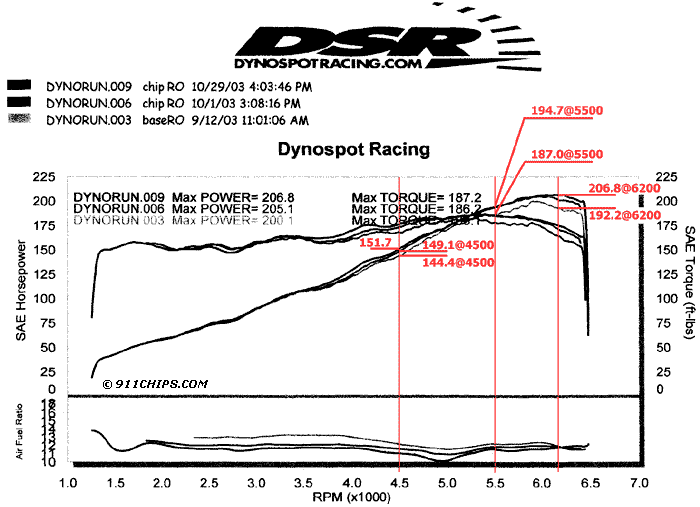
following dyno chart represents runs on a 1988 Carrera
Club Sport. The car is pristine with about 30k original
miles and starts out stock with a catalytic converter,
a Borla muffler and cone air filter. The three runs
below display the full throttle runs of the car
under three stages of modification. Three runs were
performed in each configuration, for a total of
nine runs. The best of each set are represented
below. All runs were performed in fourth gear with
the stock Fuchs wheels. All figures displayed below
are rear wheel hp numbers, and must be divided by
0.85 for the corrected crank hp values.Dynorun
003 is the lowest curve and was performed with the
factory Club Sport chip. The only engine modifications
are a Borla muffler and cone air filter. The engine
produces a maximum of 200.1 rwhp, or an equivalent
of 235.4 engine hp.Dynorun
006 is the middle curve with the only change being
the replacement of the factory Club Sport chip with
a standard 911Chips performance chip for a premuffler
exhaust tuned for 91 octane fuel. Although not programmed
specifically for a cat equipped exhaust, nevertheless,
an average of 5-8 rwhp has been gained under the
power curve from 4500 rpm on. The car produces a
maximum of 205.1 rwhp, or an equivalent of 241.3
engine hp.Dynorun
009 is the top most curve with the only change from
the previous run being the addition of a Dansk premuffler
in combination with the Borla muffler and the same
911Chips performance chip. Note how much smoother
the power curves are compared to the stock chip.
We can see some additional torque gains around 4000
rpm, along with an extended hp curve past 6000 rpm.
Peak hp has extended from 5900 to 6200 rpm with
206.8 hp. At this rpm, total hp has increased from
the stock Club Sport chip of 192.2 to 206.8 rwhp,
a difference of 14.6 rwhp, or 17 engine hp. The
final value is now 206.8 rwhp, or 243 hp corrected
to the crank.
Click
for larger image
The
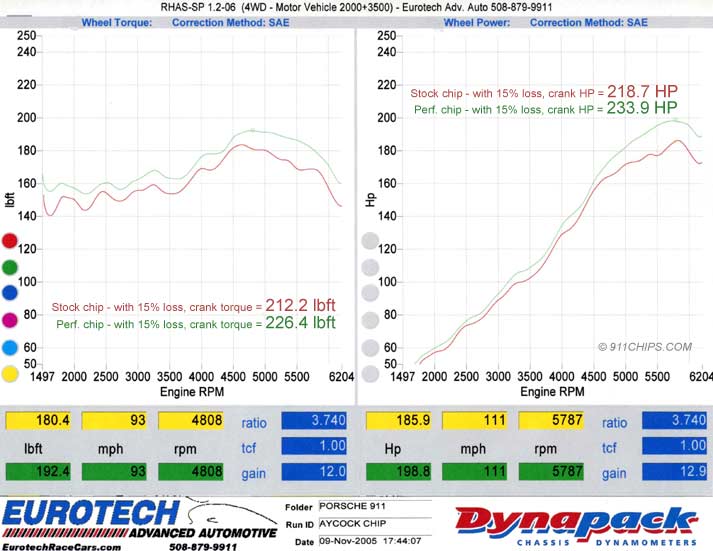
following dyno runs are from an '87 Carrera on a
DynaPack dyno performed at Eurotech
Advanced Automotive in Framingham, MA. The engine
and exhaust are completely stock with catalytic
converter. Factory rated at 217 hp and dynoing the
car with the stock chip, the engine produced a max
of 218.7 hp, and 212.2 lb-ft of torque, as shown
by the red curves below. Swapping the stock chip
with a standard 911Chips performance chip for the
stock configuration and 91 octane has increased
the peak hp to 233.9 crank hp, and 226.4 ft-lbs
of torque, a net gain of 15 hp and 14 ft-lbs of
torque as shown by the green power curves below.
The
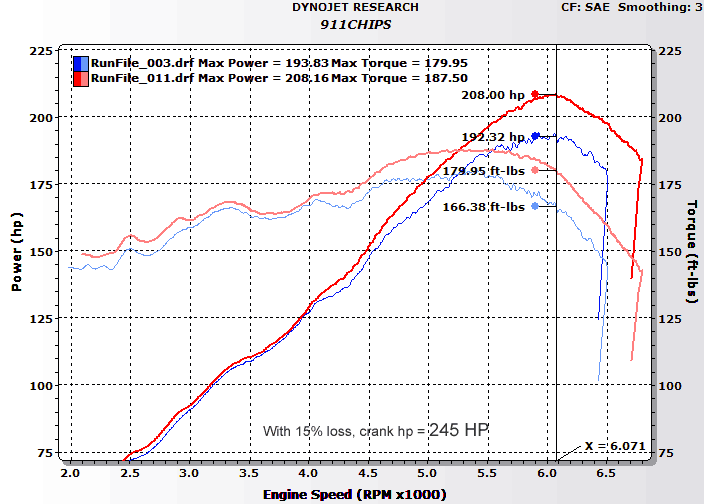
following runs are from an 85 Carrera street car we dyno tuned and live mapped on a Dynojet 248x. The engine is a stock
U.S. motor modified with a set of headers and a Dynomax muffler. The blue lines
are with a stock chip; the red lines are
with our chip mapped on the dyno for 91 octane. After tuning, the
engine produces a peak of 208 rwhp with our performance
chip. At 6100 rpm, factoring a 15% drivetrain loss,
this engine produces 245 crank hp, a 17 engine hp
improvement over the stock chip.
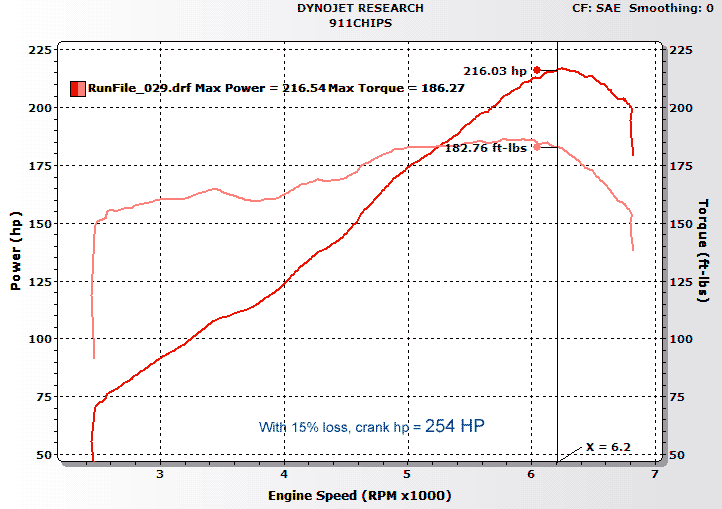
For Porsche club racing, here is a track car we dyno tuned and live mapped on a Dynojet 248c at Game-Face Motorsport in La Habra, California. The engine is a stock
U.S. motor except modified with headers and an open exhaust. After tuning the engine produces 216 rwhp. At 6200 rpm, factoring a 15% drivetrain loss,
this engine produces 254 hp at the motor.
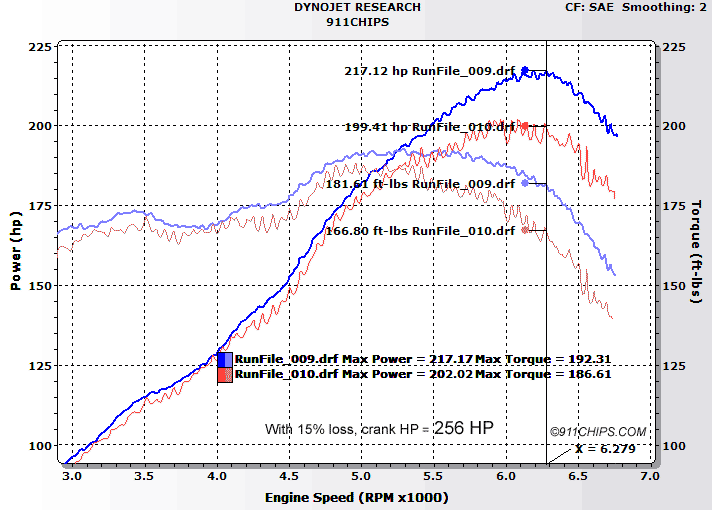
The
following runs are from an 88 Carrera POC track car we dyno tuned and live mapped on a Dynojet 424X at GT Pro in Fullerton, California. The engine is a stock
U.S. motor modified with a set of European George headers and pair of straight open mufflers. The red lines
are with a stock chip with a 6840 rev limit, and the blue lines are
with our chip live mapped on the dyno. After tuning, the
engine produces a peak of 217 rwhp with our performance
chip. At 6200 rpm, factoring a 15% drivetrain loss,
this engine produces 256 crank hp, a 18 engine hp
improvement over the stock chip along with a much smoother output.
The
following runs are from an '88 Carrera
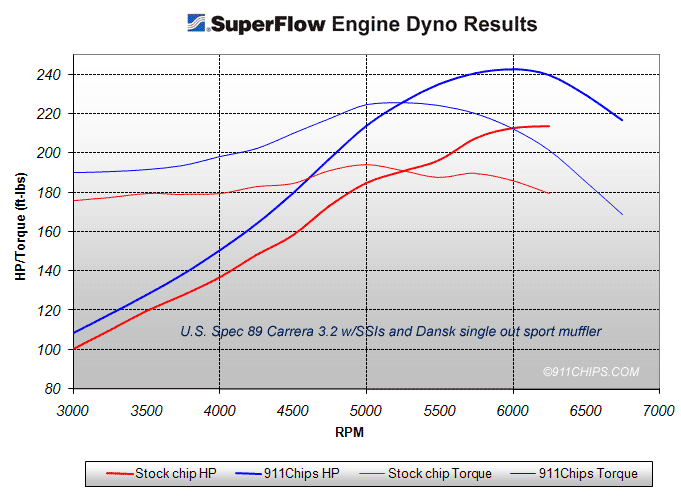
on a Superflow SF800 engine dyno at Jerry Woods Enterprises in Campbell, California. The engine is a standard
U.S. motor modified with SSI heat exchangers and a Dansk 2 in 1 out sport muffler. The red curves
are with the stock chip; the blue curves are
with a 911Chips program for the SSI exhaust
tuned for 91 octane street gas. At 6000 rpm
with the stock chip, the engine produces 213 hp. With our chip, the engine produces 243 hp, a 30 hp
improvement over the stock chip.
The
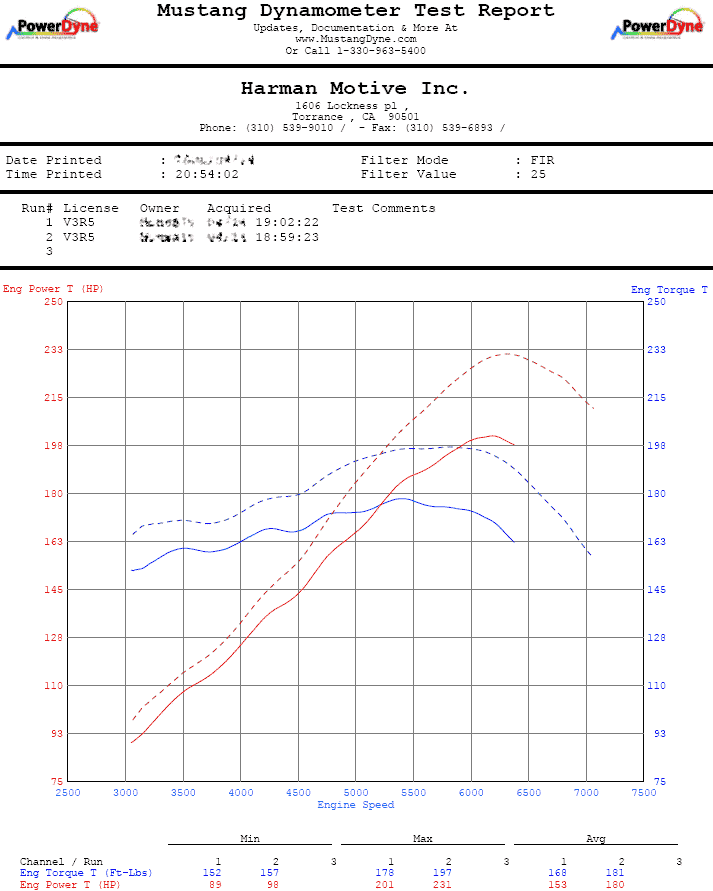
following runs are from a 3.2 Carrera we live remapped on a Mustang dyno at Harman Motive in Torrance, CA. The engine is all stock except modified with custom headers and an open exhaust prepared for track racing. Dyno'd with the stock chip, the car delivers a max of 201 hp at the rear wheels (solid curves). After remapping for the engine and race fuel, the car delivers 231 hp at the wheels, a 30 hp gain at the rear wheels (dashed curves), along with a 15-25 ft-lb torque gain throughout the rpm range. Using 15% as a transmission loss factor, engine power is now at 272 hp, with the power gain over the stock chip at 35 hp.
The
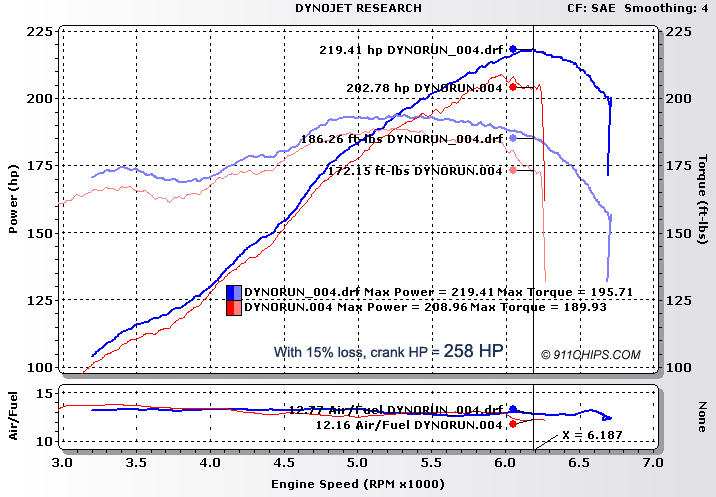
following runs are from James Achard's '87 Carrera
on a Dynojet 248c. The engine is a stock
U.S. motor with the exception of a Midnight Machine
Works header race exhaust system. The red lines
are with the stock chip, and the blue lines are
with a 911Chips program for the headers conservatively
tuned for 91 octane street gas. As we can see, the
engine produces a peak of 219.4 rwhp with our performance
chip. At 6200 rpm, factoring a 15% drivetrain loss,
this engine produces 258 crank hp, a 19 crank hp
improvement over the stock chip.
The
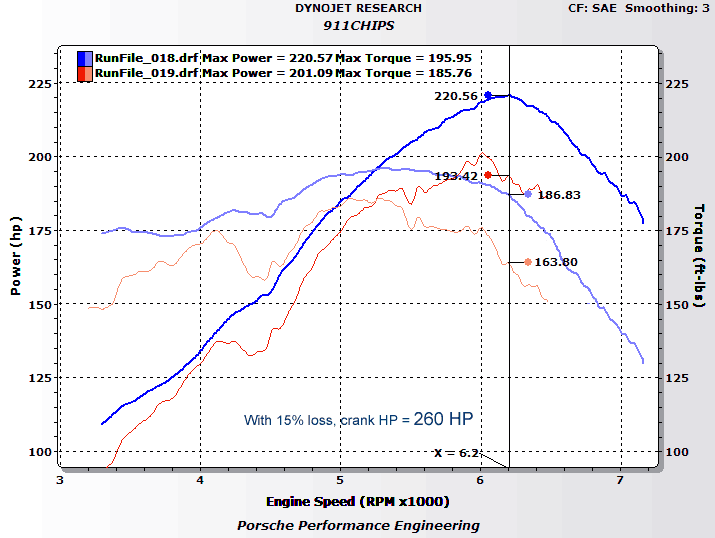
following run is from an '87 3.2 Carrera we live remapped on a Dynojet 248c at Game-Face Motorsports in La Habra, California. The engine is stock except prepped with headers and a pair of megaphones for track racing. Dyno'd with the stock chip, the car delivers a max of 201 hp at the rear wheels (red curves). Remapping for the engine and race fuel, the car delivers 220.6 hp at the wheels, a 20 hp gain at the rear wheels (blue curves), along with a 15-25 ft-lb torque gain throughout the rpm range. In addition at the peak hp point of 6200 rpm, the engine has gained 27 hp at the wheels. Using 15% as a transmission loss factor, engine power is now at 260 hp, with the power gain over the stock chip at 24 hp.
The
following run is from a stock
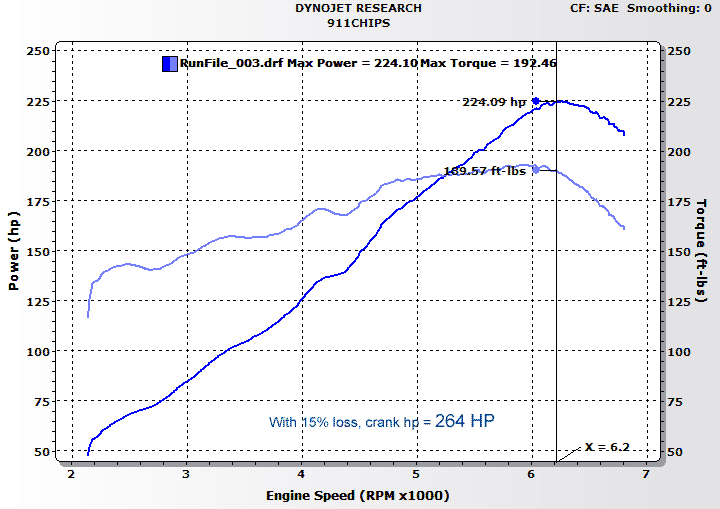
U.S. 3.2 motor prepped by Game-Face Motorsport in La Habra, California. The motor is stock with the exception of headers with sport muffler, our larger throttle body, and camshaft to serve as a dual purpose street and track car. Dyno tuned and tested for 91 octane pump gas on a Dynojet 248c, at 6200 rpm, factoring a 15% drivetrain loss,
this engine produces 224 HP at the rear wheels, or factoring a 15% transmission loss, produces approximately 264 HP at the engine.
The
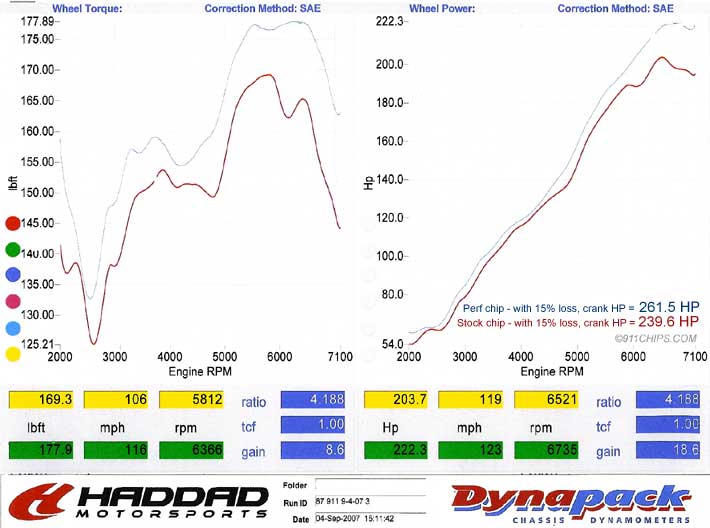
following runs are from an 88 Carrera track car we live mapped on a Dynapack dyno. The engine is a stock
U.S. motor modified with a set of mild cams, headers and pair of straight open mufflers. The red lines
are with a stock chip with a 6840 rev limit, and the blue lines are
with our chip after the live remap. After tuning, the
engine produces a peak of 223 rwhp with our performance
chip. At 6200 rpm, factoring a 15% drivetrain loss,
this engine produces 261 crank hp, a 22 engine hp
improvement over the stock chip.
The
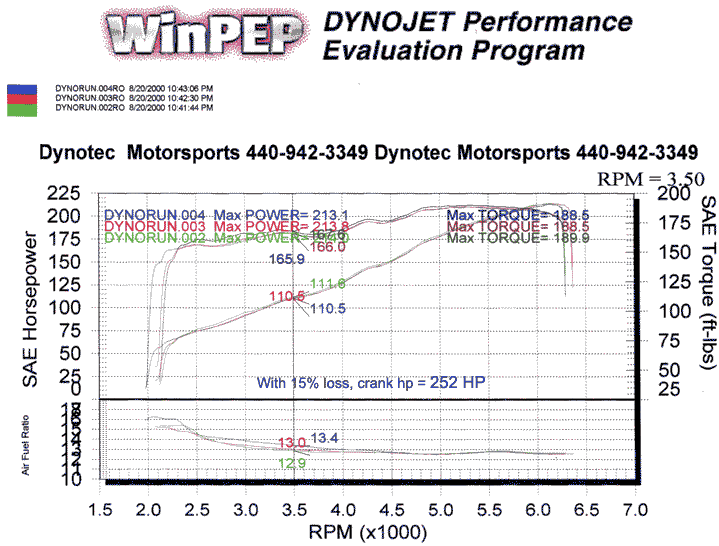
following are three runs from Chris H's U.S. spec
86 Carrera modified with SSI heat exchangers, twin
plug ignition, ExtrudeHoned manifolds, and a 911Chips
program matched to the client's mass air flow meter
for the configuration. On this dyno, dynorun 002,
best of three, produces 214.0 rwhp at 6200 rpm.
Factoring a 15% drivetrain loss, this engine produces
252 engine horsepower.
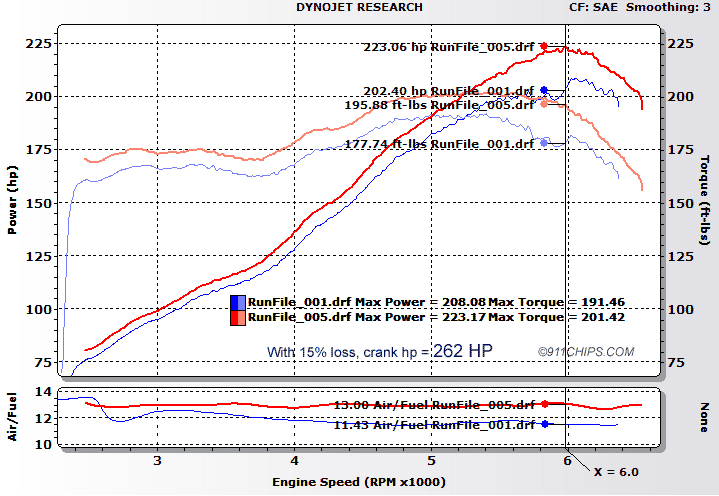
With
various modifications, often times a custom tuned
chip from your dyno air/fuel ratio data is the best
way to assure maximum power. The following runs
are from an '84 3.2 Carrera on a Dynojet 248c. The
engine is built with the following: Euro compression
pistons, SSI heat exchangers, a dual out sport muffler,
ExtrudeHoned intake manifolds, and Webcam camshafts.
Originally dynoed with a Weltmeister performance
chip, the engine produced 208 hp at the wheels,
as shown by the blue curve. While the 208 rwhp is
respectable, it is underwhelming for the cost and
extent of engine modifications performed. In addition,
the driveability was described as lagging and very
flat. Examining the air/fuel curve, we can see that
the chip is running an air fuel ratio in the mid
11s, much too rich for maximum power. Providing
us the dyno air/fuel data, a custom chip was mapped
optimizing the air fuel ratios, while revising the
part throttle maps for maximum driveability, throttle
response, and torque. Programmed for 93 octane fuel,
max ignition timing remains relatively unchanged
over the Weltmeister. As a result, the car dynoed
223 rwhp, a 15 rwhp gain (18 at the engine) over
the Weltmeister chip. Factoring in a 15% drivetrain
loss, the engine now produces 262 hp at the crank.
The
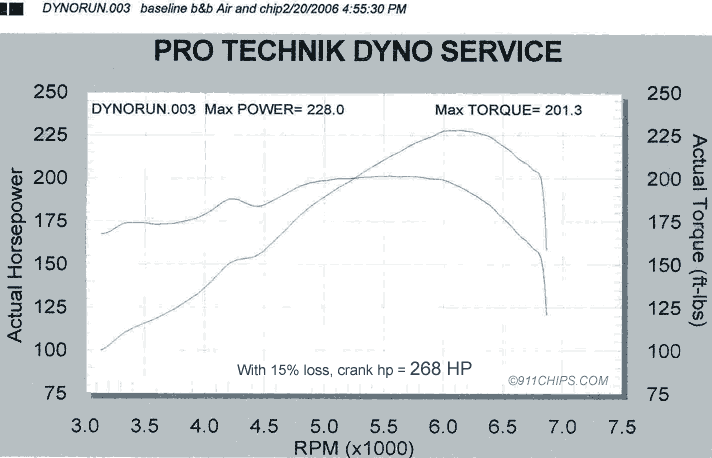
following run is from an '89 3.2 Carrera on a Dynojet
248c at Pro Technik in Houston, Texas. The engine is modified with a B&B header exhaust system along with our chip
program for the engine combination and 93 octane
fuel. The engine produces a peak of 228 rwhp with
our performance chip. At 6200 rpm, factoring a 15%
drivetrain loss, this engine produces 268 crank
hp.
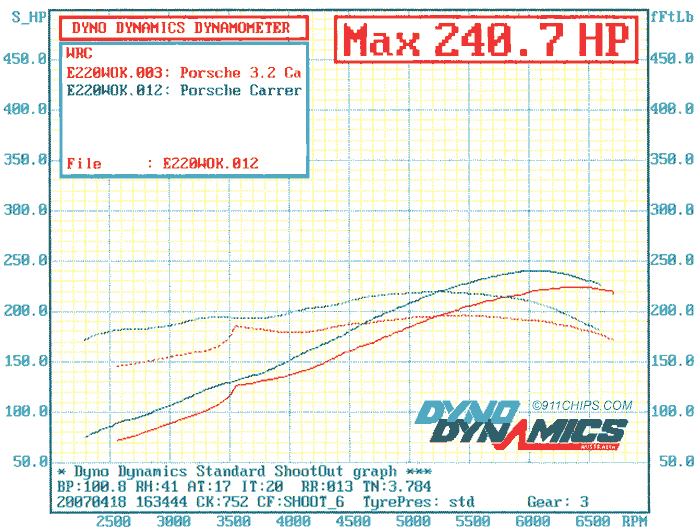
The
following chart is from Richard Simpson's European spec '88 Carrera
on a Dyno Dynamics machine at Weltmeister's facilities in the U.K. Dyno Dynamics machines display
hp corrected to the engine, not wheels. The engine
and exhaust are stock. Dynoing the car with the
stock chip, the engine produced a max of 223 crank
hp, shown by the red power curve below.
The stock chip was subsequently replaced with our
performance chip for the Euro spec Carrera and 95
European RON octane fuel (equal to ~91 U.S. octane). The resultant redyno produced
240.7 hp at 6100 rpm (shown by the blue curve), a
18 hp gain over the stock chip, with nice average 20 hp and 20 Ft-lb gain in torque throughout the rpm range!
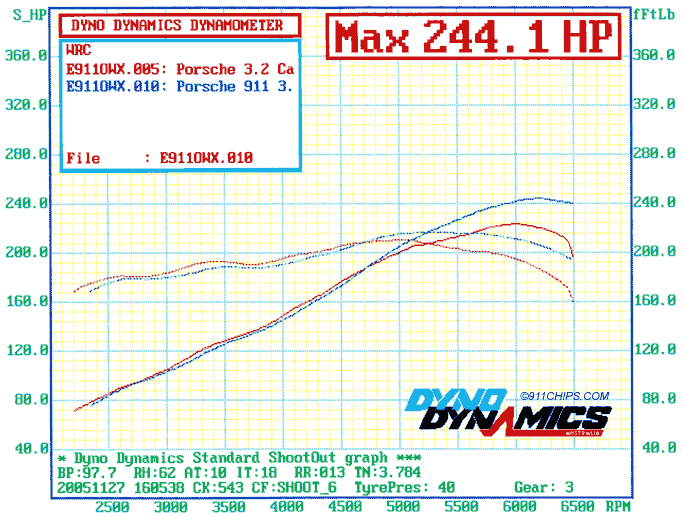
The
following chart is from an European spec '87 Carrera
on a Dyno Dynamics machine at Weltmeister's
facilities in the U.K. Dynoing the car with the
stock chip, the engine produced a max of 223 crank
hp at 6000 rpm, shown by the red power curve below.
The stock chip was subsequently replaced with our
performance chip for the Euro spec Carrera and 98
European RON octane fuel. The resultant redyno produced
244 hp at 6200 rpm (shown by the blue curve), a
21 hp gain over the stock chip, with a 30 hp gain
around 6500.
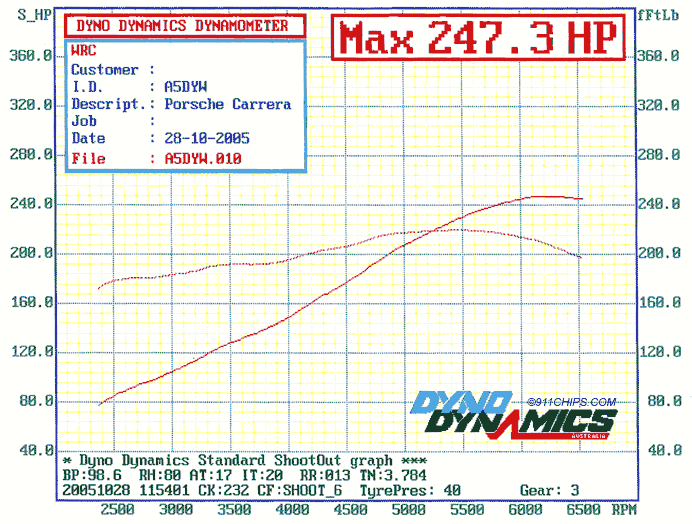
The
following dyno runs are from John Parry's U.S. version
'89 Carrera, also on Weltmeister's
Dyno Dynamics machine. The engine is stock, with
the exception a Euro premuffler in place of the
stock catalytic converter. The chip dynoed is the
standard 911Chips program for a U.S. specification
3.2 for the sport exhaust/premuffler setup and 91
U.S./95 RON European octane fuel. The results displayed
are corrected to engine flywheel HP. Stock Carreras
on Weltmeister's dyno often dyno between 220-230
hp on a regular basis with the stock chip, just
as the car above. As seen here, with just the replacement
of the stock chip with our performance chip, this
Carrera produces 247 hp, 24 more hp than Euro 3.2
above using the stock chip, and is actually 3 hp
stronger than the same Euro 3.2 after chipping.
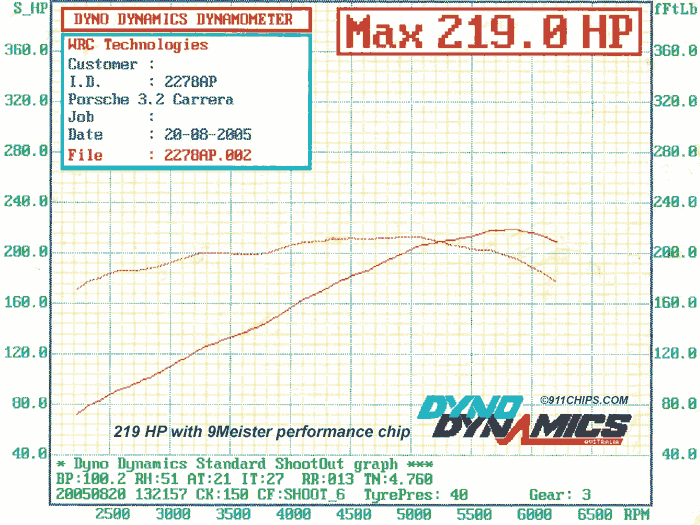
The
following dyno runs are from Alan Pole's European spec '88 Clubsport on Weltmeister's Dyno Dynamics machine. The engine is stock with the exception of a NineMeister custom performance chip. As can be seen the engine develops a maximum of 219 hp at the engine at 5900 rpm. The next chart after this is the same 88 Clubsport redynoed with a 911Chips performance chip.
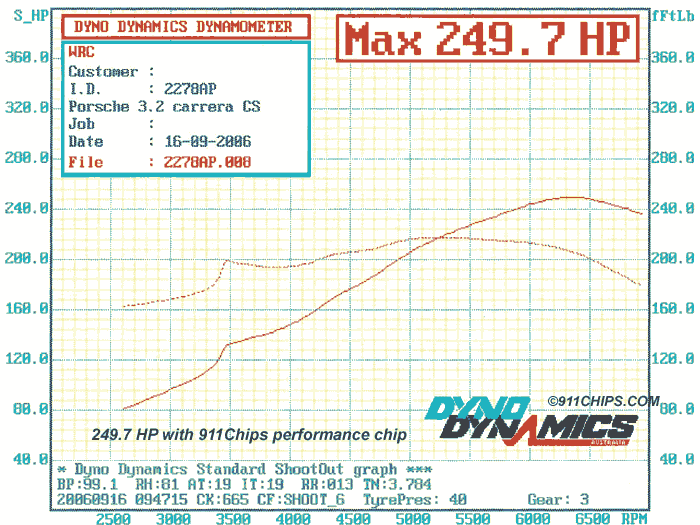
The NineMeister performance chip was then swapped with our performance chip in this same '88 Clubsport and remeasured again at Weltmeister's dyno. The resultant horsepower is now 249.7 at 6400 rpm, a nice increase of 30.7 HP.
The
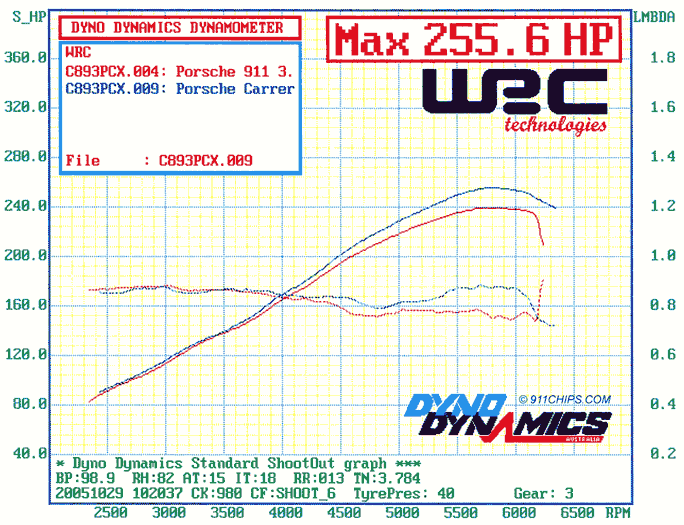
following dyno runs are from Ian Highfield's Euro
spec '86 Carrera also on Weltmeister's
Dyno Dynamics machine. The engine is stock, with
the exception of a sport muffler which was used
on both runs. Dynoing the car with the stock chip,
the engine produced a max of 239.6 crank hp, shown
by the red power curve below. In addition, the air/fuel
ratio, or Lambda, shown by the lower red curve indicates
the stock chip is excessively rich, acting like
a fire extinguisher dampening out the potential
combustion energy attainable. A custom chip was
then developed for the client from this data, from
which the fuel mixtures were corrected to the optimum
power point along with program optimization for
98 European RON octane fuel. The resultant redyno
produced 255.6 hp, a 16 hp gain over the stock chip.
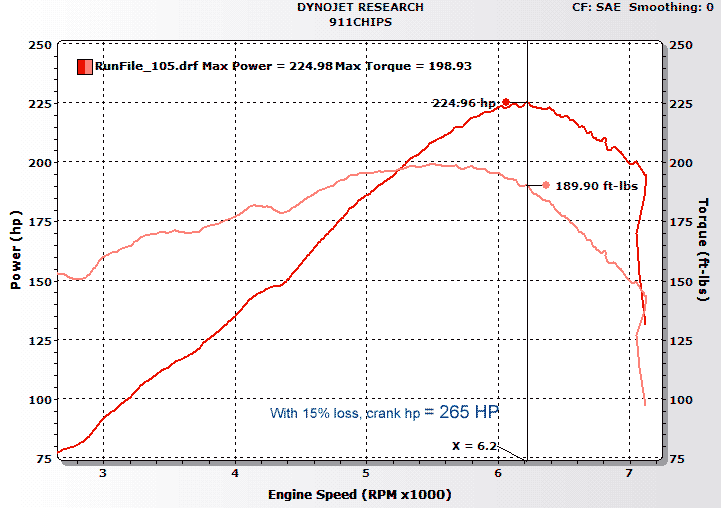
For Porsche club racing, the following is a 3.2 track motor and car by AASE Motors in Fullerton, California
. The motor is set up running 3.2 U.S. compression pistons and cams, with headers and an open racing exhaust. Live mapped on a Dynojet 242c and programmed to run on race fuel, this motor produces 225 hp at the rear wheels. Factoring in a 15% transmission loss, this motor produces 265 hp at the flywheel. Subsequently, the driver of this car is a frequent top time of the day holder at Porsche club events. Kudos to the work of AASE and the talent of the driver!
The
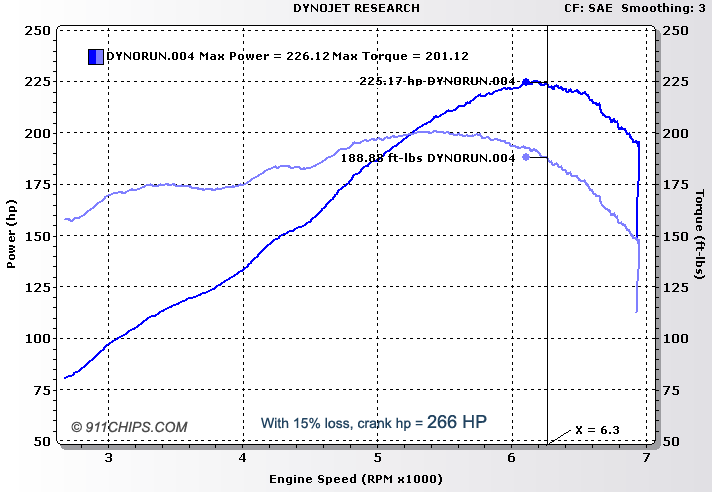
following run is from an '87 3.2 Carrera on a Dynojet
248c. The engine is modified with the following:
Euro compression pistons, SSI heat exchangers, GHL
muffler, ExtrudeHoned intake manifolds, Webcam 20/21
cams, and ARP bolts. The chip is a custom 911Chips
program for the engine combination and 93 octane
fuel. The engine produces a peak of 226 rwhp with
our performance chip. At 6200 rpm, factoring a 15%
drivetrain loss, this engine produces 266 crank
hp.
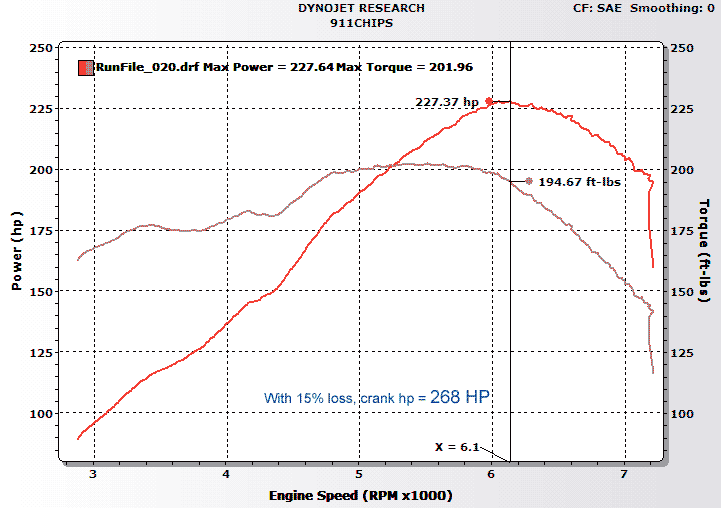
For Porsche club racing here is a 3.2 Carrera track car built and prepped by AASE Motors in Fullerton, California. Built as spec motor with headers and stock cams that live mapped on a Dynojet
248c, with our program custom tuned and programmed for race fuel, the engine produces an outstanding 228 rwhp. Factoring a 15%
drivetrain loss, this engine produces 268 engine crank
hp. Shortly afterwards, the driver broke and set a new class track record. Congrats!
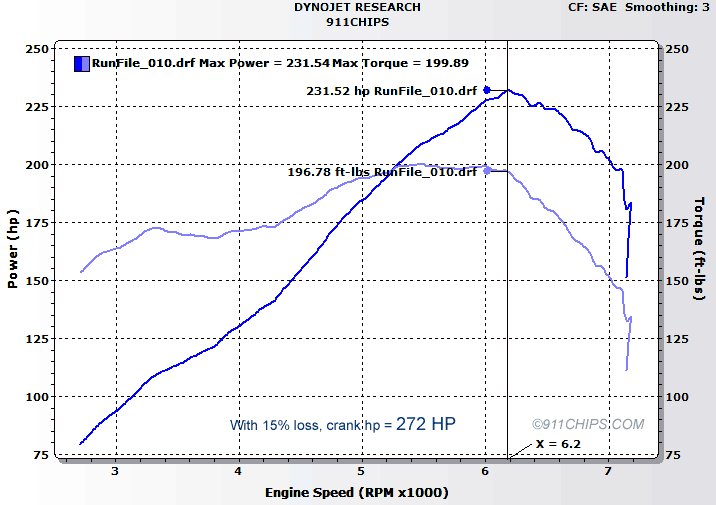
The
following run is from an '86 3.2 Carrera live tuned on a Dynojet
424x. For POC racing, the engine is completely stock with the exception of a set of custom stepped racing headers and open exhaust. With our program custom tuned and developed at the dyno for race fuel, the engine produces an outstanding 231 rwhp at 6200 rpm. Factoring a 15%
drivetrain loss, this engine produces 274 crank
hp.
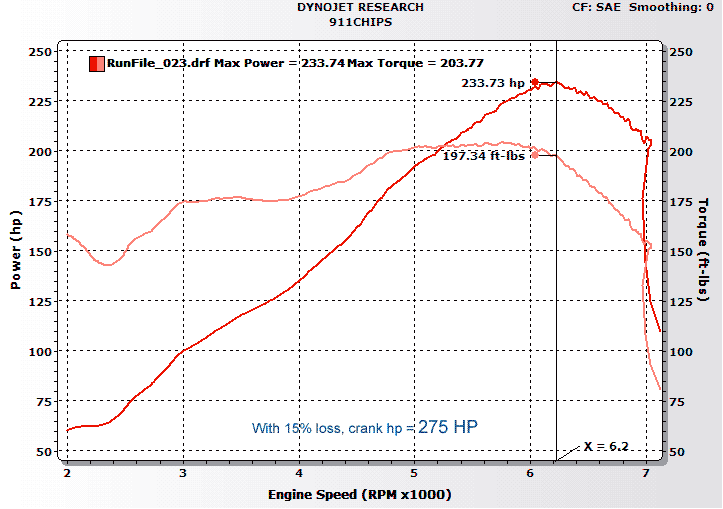
For POC Porsche club racing, here is a '88 Carrera 3.2 track car built by Vision Motorsports in Laguna Hills, California. The engine, modified with headers and an open exhaust, and dyno tested on Vision's Dynojet, and tuned to run on race fuel, produces an amazing 233.7 hp to the rear wheels, or assuming a 15% transmission loss, is approximately 275 hp at the engine.
The
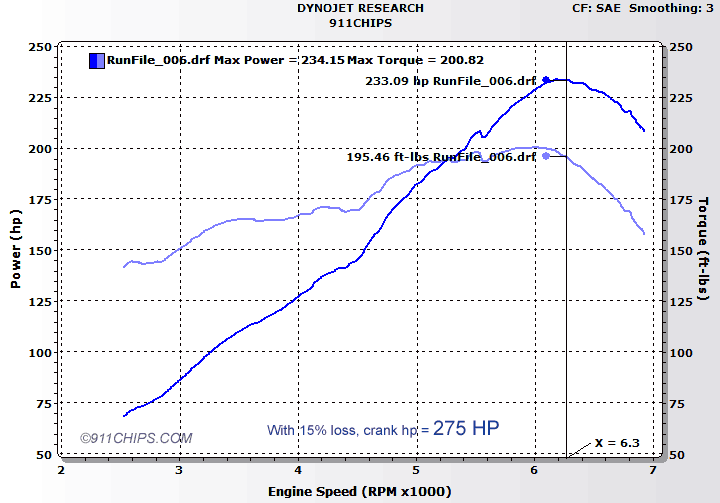
following run is from an '87 3.2 Carrera built by Autometrics Motorsports in Charleston, South Carolina on a Dynojet
248c. The engine modifications include the following:
10.3:1 cr pistons/cylinders, 964 cams, and headers with racing mufflers. The chip is a custom 911Chips
program for the engine combination and 93 octane
fuel. The engine produces a peak of 234 rwhp with
our performance chip. At 6200 rpm, factoring a 15%
drivetrain loss, this engine produces 275 crank
hp.
The
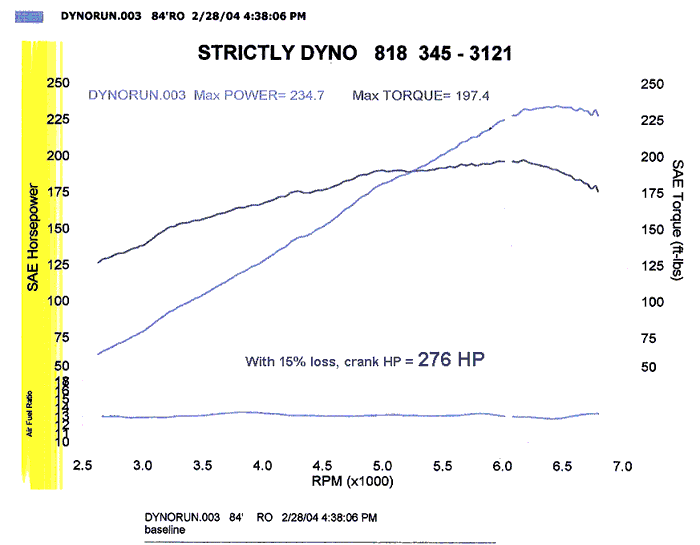
following is from a custom built '84 3.2
by TRE Motorsports
on a Dynojet 248c. The combination of the engine
build, TRE's race exhaust system, along our chip
programmed for the engine package produces 234.7
rwhp at 6500 rpm. Factoring a 15% drivetrain loss,
crank hp is 276 hp, a 69 hp improvement over the
stock 207 hp motor. Not bad considering the entire
intake and fuel injection system remains completely
stock and unmodified due to POC class restrictions.
Examining the torque curve, not only does it build
smoothly to 5000 rpm, but doesn't stop rising until
it it peaks out at 6200 rpm! Area under the curve
from 4800-7400 rpm is what allows this car to fly.
This car outruns track prepped Vipers and E46 M3s
at the track as if they were driving Miss Daisy.
(Motec? We don't need no stinkin' Motec! :-) )
The
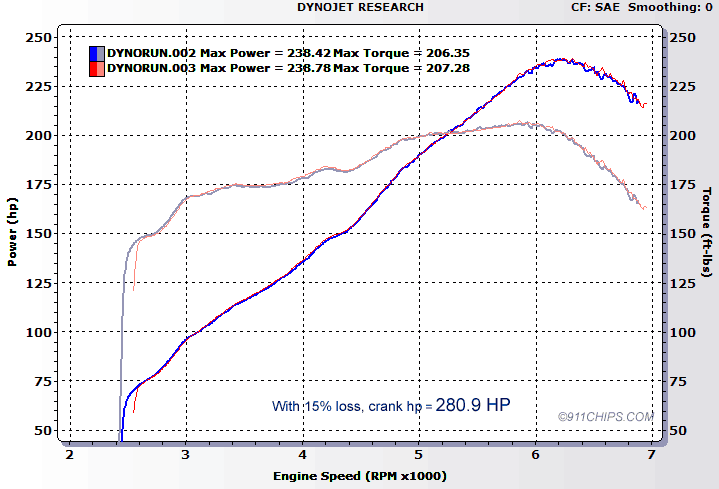
following runs are from an '84 3.2 Carrera on a Dynojet
248c. The engine is modified with the following:
Euro compression pistons, racing headers, megaphones, ARP rodbolts, 9K valve springs, a racing valve job with polished ports, and Webcam 20/21
cams. The chip is a custom 911Chips
program for the engine combination and 93 octane
fuel. The engine produces a peak of 238.8 rwhp with
our performance chip. At 6200 rpm, factoring a 15%
drivetrain loss, this engine produces 281 crank
hp. The following weekend the owner won the PCA time trial class at Willow Springs. Weekend following, he also won his PCA time trial class again at California Speedway, in addition to being 9th overall out of 51 cars, beating at least six 3.6L powered 911s as well as several track prepped and tricked out 944 turbos.
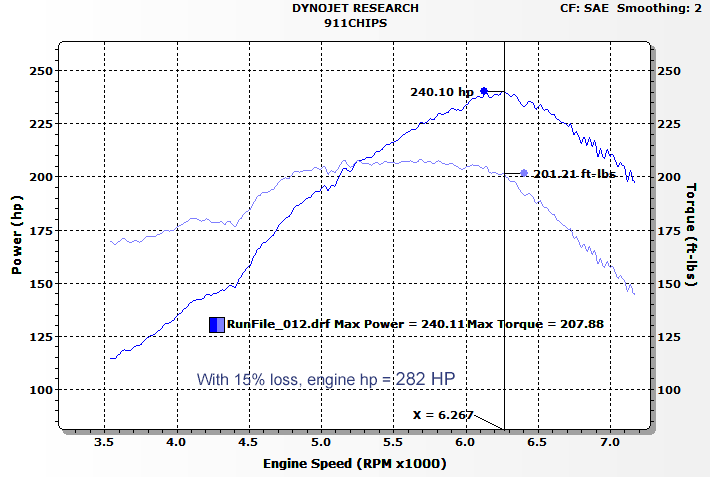
For Porsche club racing, for a class that calls for US factory stock spec internals, this 3.2 was built by AASE Motors to spec 9.5 CR compression pistons, using the stock cams, a modified MSDS cone air intake, and a set of AASE custom headers with open exhaust. Tuned for race fuel, this motor puts out 240 HP at the rear wheels on a Dynojet 248c, or approximately 282 HP at the motor factoring a 15% transmission loss.
The
following is an '89 3.2 to 3.4 liter
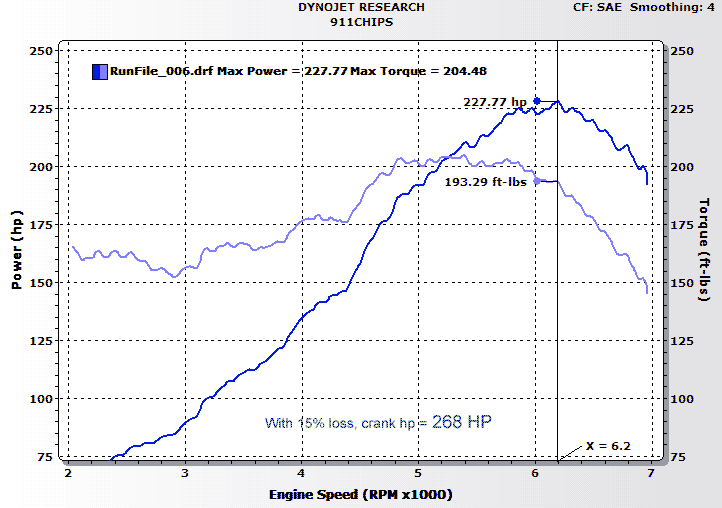
conversion by Callas Rennsport in Torrance, California. The car, designed as a daily driver to run on 91 octane pump gas, is built with Mahle pistons and cylinders, special camshafts, ARP rod bolts, Extrude Honed manifolds, utilizing the stock exhaust with a our premuffler and a M&K sport muffler. After dyno tuning and live mapping for a new chip for the motor on a Dynojet 248c, at 6200 rpm the motor produces a very nice 228 hp to the rear wheels, along with a peak torque of 204 ft-lbs to the wheels, a nice torque increase of about 30 ft-lbs over a stock 3.2.
The
following is from an '86 3.2 rebuilt to 3.4 liters
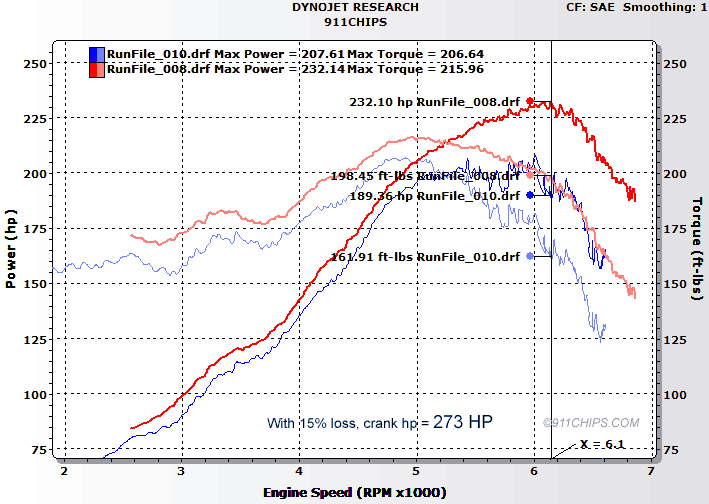
by TRE Motorsports tuned on a Dynojet 248x. The engine is built with Mahle pistons and cylinders, Webcam camshafts, Extrude Honed intake manifolds, ARP rod bolts, keeping the stock exhaust and muffler along with a sport cat. With a stock chip from an 87 Carrera, the car dynos a max of 207.6 hp, or 244 hp corrected to the engine, as shown by the blue lines in the below chart. With our chip live tuned on the dyno on 91 octane, the engine produces a new max of 232 hp at the wheels, or 273 hp corrected to the engine, a 29 hp gain at 6100 rpm, along with a much smoother power output as shown by the red curves. Examining closely, you can see at 5500 the car has gained 23 hp at the wheels (27hp at the engine) and at 6500 the engine has gained 51 hp at the wheels (60 hp at the engine)!
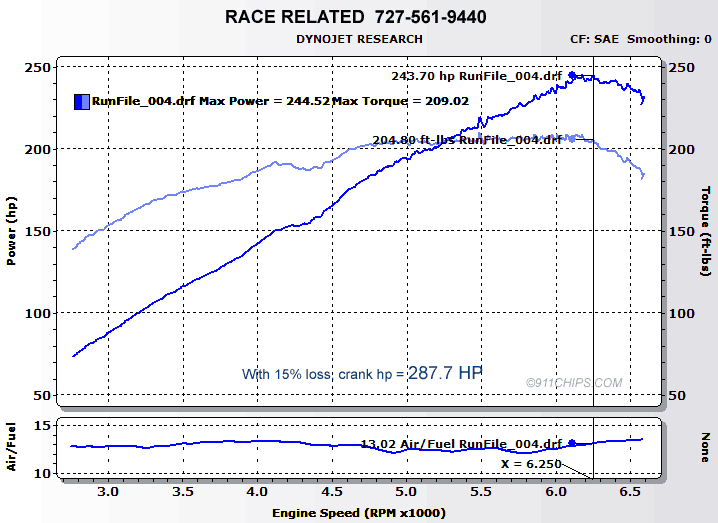
Here
is Jeremy Dixon's '87 Carrera which was rebuilt
from 3.2 liters to 3.4 liters with a Malhe 3.4l 9.8:1 piston and cylinder conversion set. The engine is modifed
with the following: 1 3/4" B&B headers, ExtrudeHoned intake manifolds,
FFenSport bored throttle body, 993SS cams, ARP rod bolts, Competition springs and retainers, and a Magnaflow muffler. Along
with our custom chip for a 3.4 conversion programmed
for 93 octane fuel, the engine produces a peak of
244 hp at the rear wheels.Factoring a 15% drivetrain
loss, the engine produces 288 hp at the crank.
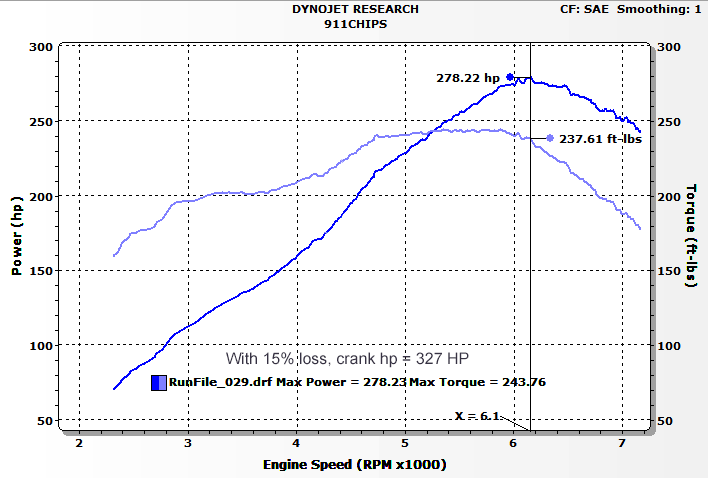
For Porsche club racing this 3.2 was rebuilt by AASE Motors into a 3.4 with 10.8:1 compression, cams, our rebored throttle body, a modified MSDS cone filter, and a set of AASE stepped headers with an open exhaust. Tuned to run on race fuel, this motor produced 278 hp at the wheels on a Dynojet 248c. Factoring a 15% drivetrain loss, the engine produces 327 hp at the flywheel.
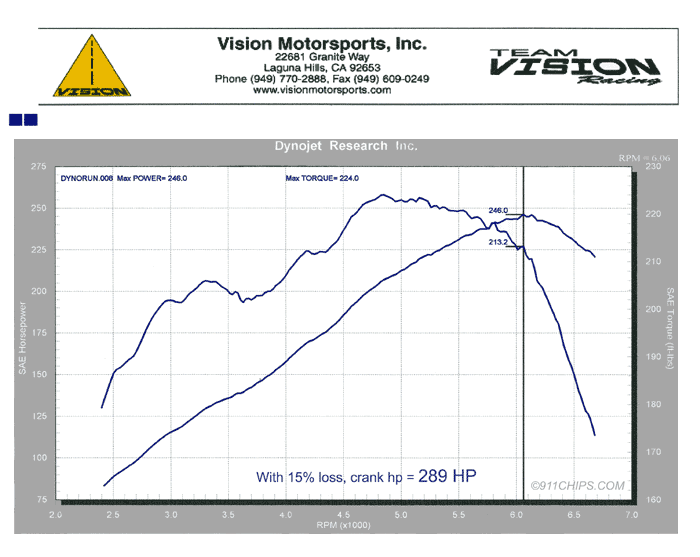
Here
is Ralph Hollack's '89 Carrera which was rebuilt
from 3.2 liters to 3.5 liters with a Mahle piston
and cylinder conversion set. The engine is modifed
with the following: twin plugs, European George
1 5/8" headers, ExtrudeHoned intake manifolds, FFenSport
bored throttle body, Webcam 20/21 cams, mildly ported
heads, and a Dansk twin out sport muffler. Along
with our custom chip for a 3.5 conversion programmed
for 91 octane fuel, the engine produces a peak of
246 hp at the rear wheels on Vision
Motorsports' Dynojet 248c. Factoring a 15% drivetrain
loss, the engine produces 289 hp at the crank. For
more details, read about it
in European Car Magazine here, and in the Pelican Parts forum here.
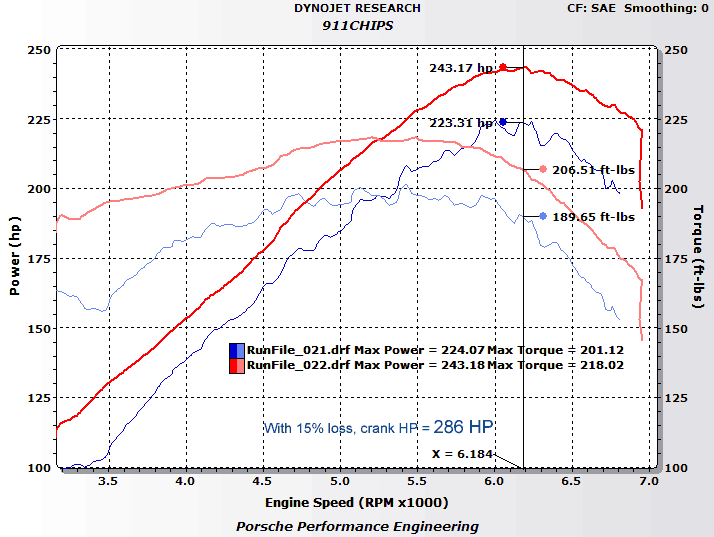
Here is another 3.2 to 3.5 conversion we tuned for an '88 Carrera on a Dynojet 248c. The engine has been built with Mahle 3.5 pistons and cylinders, along with headers and different camshafts. Dynoed with the stock factory chip, the engine makes a max of 224 rear wheel HP, or 263 HP at the engine factoring a 15% drivetrain loss, shown in the blue curves below. Live mapped on the dyno to optimize the fuel and ignition maps, this engine develops 243 HP at the wheels at 6200 rpm, or 286 HP at the engine, along with a much smoother power curve as shown in the red curve below. Result is a net HP gain of 23 hp at 6200 rpm, along with a broad range gain in torque of about 20 ft-lbs with as much as a 45 ft-lb torque gain at 3500 rpm and 30 hp gains in the 6500+ rpm range.
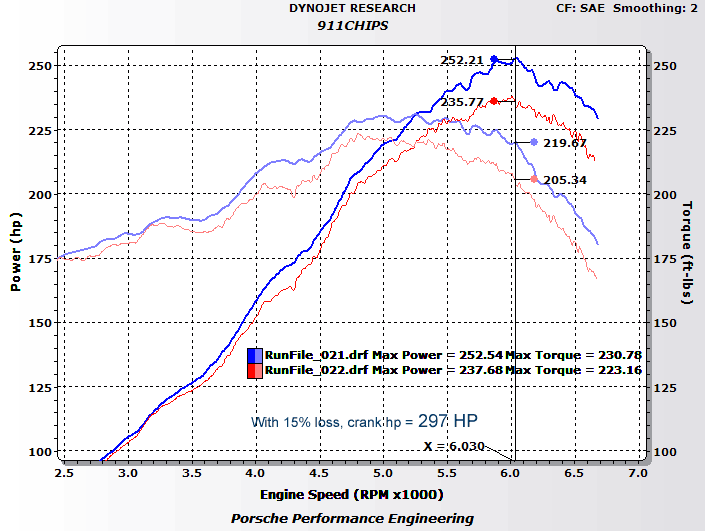
The following dyno runs are from a '94 964 C2 performed on a Dynojet 248x. Engine is completely stock with catalytic converter with the exception of a muffler bypass, cut open airbox cover, RS lightweight flywheel and pressure plate, and our 964 performance chip. Dynoed with 91 octane California pump gas, this car produces 238 hp at the rear wheels with the stock chip (red curves). With our retuned performance chip, the car now dynos 252 hp at the rear wheels (blue curves). Calculating for a 15% transmission loss, this engine produces 297 HP at the crank, a 17 hp improvement at the engine.
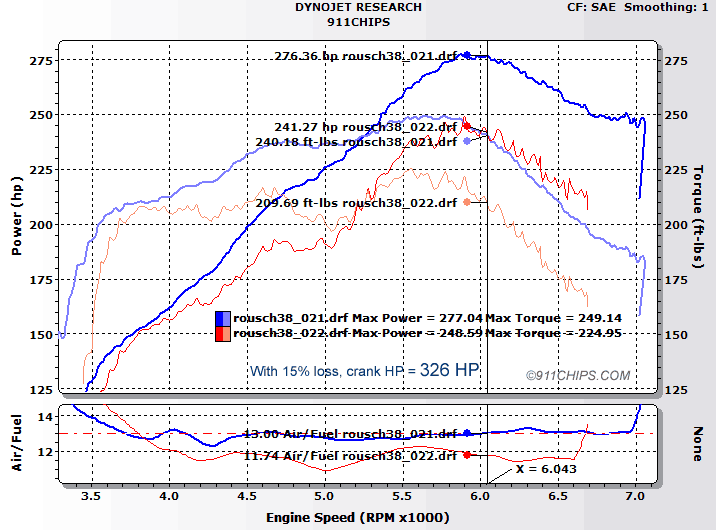
The following runs are from a freshly built 91 964 race car from Kevin Roush of GAS Motorsports in Upland, California. The engine is modified with the following: 3.8L piston/cylinder set, cams, ARP rod bolts, an ultralight flywheel and clutch, and a custom GAS Motorsports 2 in 1 out exhaust with headers. The intake system is stock. With the ultralight flywheel and radical cams, not only did we fix the idle and stalling problem of the stock chip, but did so while retaining an 800 rpm idle. Dynoed with a factory 964RS chip, this engine produced a maximum of 248.6 HP and 225 lbs of torque at the rear wheels on a Dynojet 248c. (red curves) With our custom remap for the engine modifications and 100+ octane race fuel, the engine produces a much smoother output with a max of 277 hp and 249 lbs of torque at the rear wheels, a gain of 29 rear wheel hp, or 34 hp at the engine. (blue curves) If you look closely, at 5000 rpm, the engine has gained 35 rwhp - 41 hp at the crank, and at 6500 rpm, the engine has gained 43 rwhp - 50 hp at the engine! Factoring a 15% drivetrain
loss, the engine has gone from producing a max of 292 hp at the crank, to 326 hp at 6000 rpm, exceeding the ouput of the factory 964 RSR race cars.
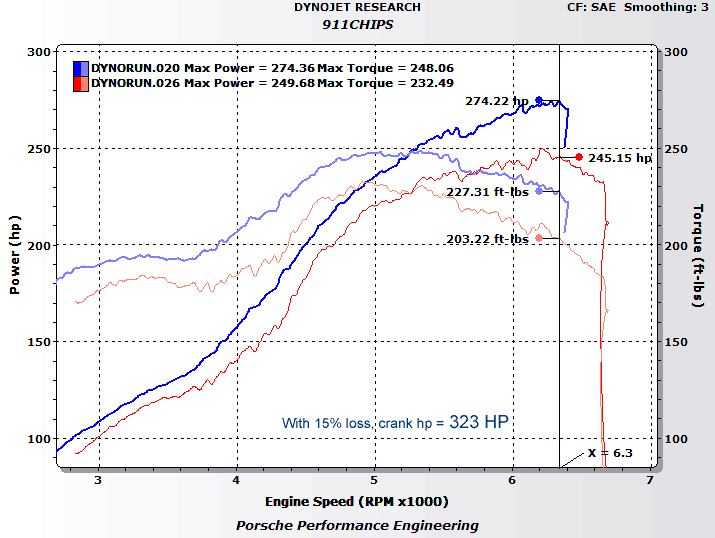
The
following is another modified 964 we custom tuned. The engine has been freshly rebuilt and modifed with 3.8L pistons and cylinders, cams, headers, street mufflers, lightweight flywheel, and some headwork. Dynoed on a Dynojet 248 with the stock chip, the engine produces a max of 250 HP at the wheels, or 294 hp at the engine - red curves below. After custom remapping a new chip from the dyno data for the engine combination and 91 pump fuel, the engine now produces 294 hp at the wheels at 6300 rpm - blue curves below. Factoring a 15%
drivetrain loss, this engine produces 323 crank
hp, net gain of 29 hp along with a broad based torque gain of 20-25 ft-lbs throughout the rpm range.
The
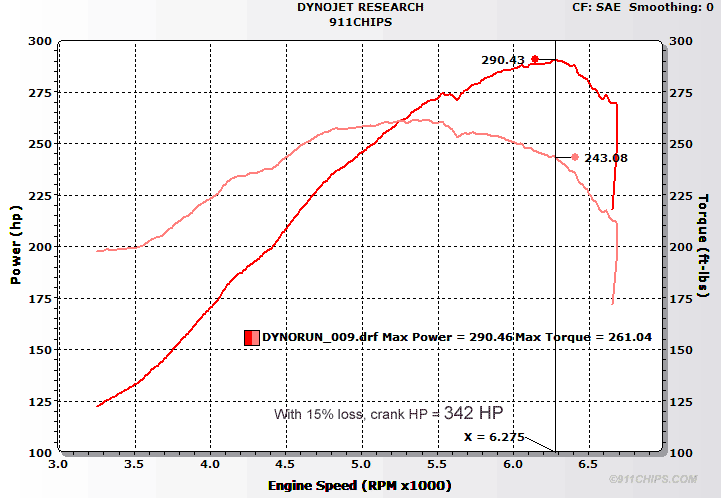
following run is from another 964 race car on a Dynojet
248c built by Planet 9 Eleven in Edmond, OK. The engine has been freshly rebuilt and modifed with 3.6L pistons and cylinders, Pauter rods, headwork, cams, 993 heat exchangers, racing mufflers, and a lightweight flywheel. The chip is a our custom remap for the engine combination and 110 octane race fuel. At 6275 rpm, factoring a 15%
drivetrain loss, this engine produces 342 crank
hp.
The
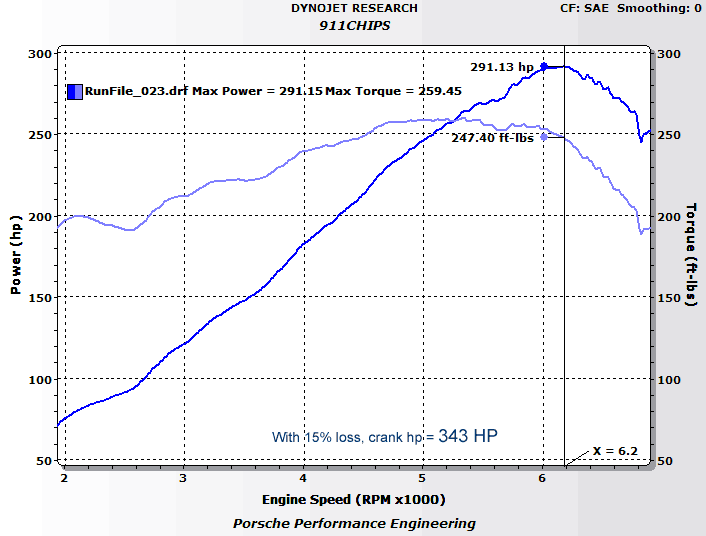
following run is from a 964 race car on a Dynojet
248c built by Autometrics Motorsport in Charleston, S.C. The engine has been freshly rebuilt and modifed with 3.8L pistons and cylinders, cams, headers, racing mufflers, a lightweight flywheel, and a modified intake. The chip is a our custom remap for the engine combination and 100+ octane race fuel. At 6200 rpm, factoring a 15%
drivetrain loss, this engine produces 343 crank
hp.
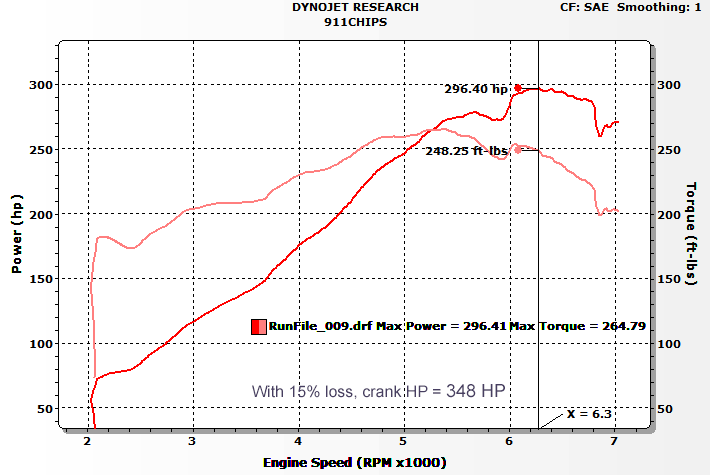
This is Dennis Gong's '95 3.6 993 motor rebuilt with Elgin cams, running headers and an open exhaust. Everything else is otherwise stock. Tuned on a Dynojet 248c, this motor produces 296 hp at the wheels, or factoring a 15% drivetrain loss, is 248 HP at the flywheel. Probably our highest dyno'd 3.6 to date. Dennis' car is consistenly the FTD car at Speed Ventures events.
This is Bob Gangon's '95 993 rebuilt by Bob with Mahle 3.8 pistons and cylinders, Schrick cams, VRAM sized valves, mechanical rockers, a GT3 bottom end with 130mm Ti rods, RS 4.0 flywheel, a GT3 oil pump w/a special Porsche Motorsport crankcase vent valve, headers with a sport muffler, and tuned for 91 octane fuel. Tuned on a Dynojet 248c, this motor produces 288 hp at the wheels, or 334 hp at the flywheel.
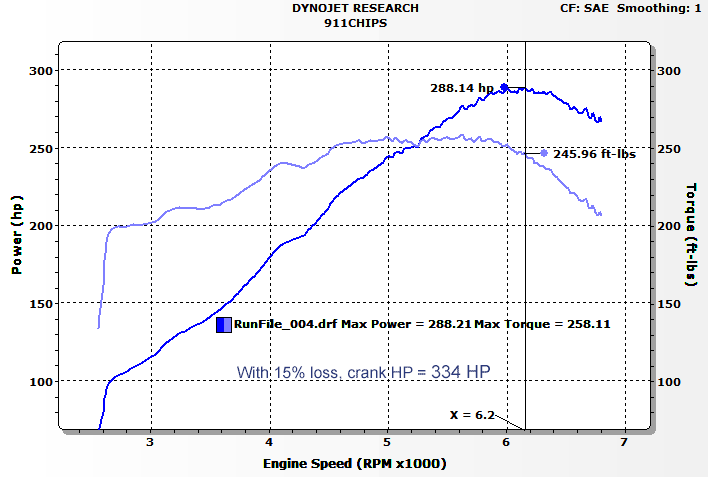
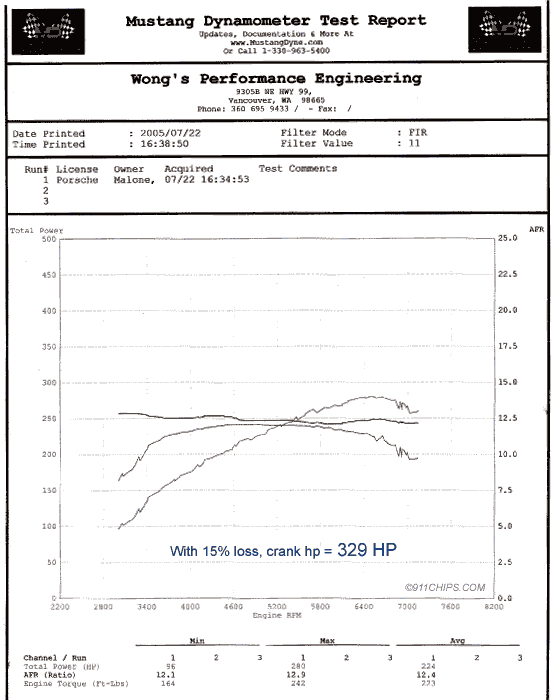
The
following is a 97 Euro version V-ram 993 measured
on a Mustang dyno. The results shown are after installation
of our chip which show a max of 280 rear wheel hp at 6500 rpm. Factoring a 15% drivetrain loss,
this calculates to 329 hp at the engine. Previously
this car had another company's performance chip,
which caused the car to run a lean part throttle
air fuel ratios, and full throttle upper rpm AFRs
were at 11.0:1, much too rich for optimum power.
The client was consistenly passed by a 600 hp Camaro
at the track. The following weekend after installation
of our performance chip, the client won two races,
plus, that Camaro was no longer passing his 993
:-).
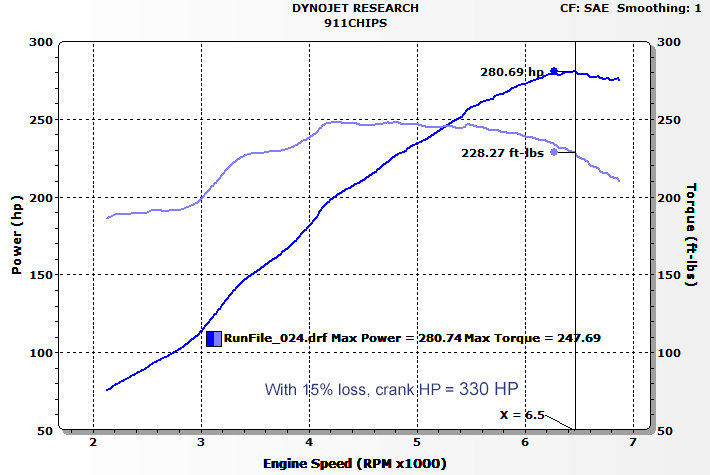
The following is a stock 3.6 VRAM 993, modified with a set headers and an open race exhaust. The motor is otherwise completely internally stock. Dyno tuned on a Dynojet 248x for race fuel, this motor produces 281 hp at the wheels, or 330 HP at the motor assuming a 15% transmission loss.
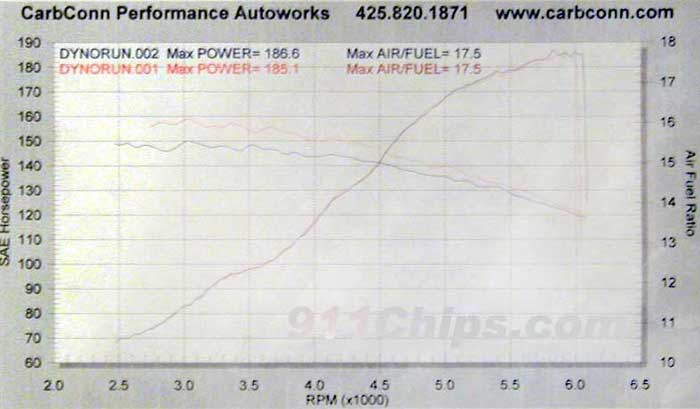
The
following dyno chart is a typical fully stock
factory 911 3.2L Carrera performed on a Dynojet
dynamometer. The car is an 87 with the factory
28 pin 1267355358 chip, which also came on many
of the 88-89 U.S. Carreras. It was the most aggressive
of the series of chips delivered for the Carreras,
as they were factory rated at 217 hp. The dyno
results shown below measure and represent rear wheel
horsepower. Factoring a drivetrain loss of 15%,
the 186 rwhp works out to 219 flywheel hp.
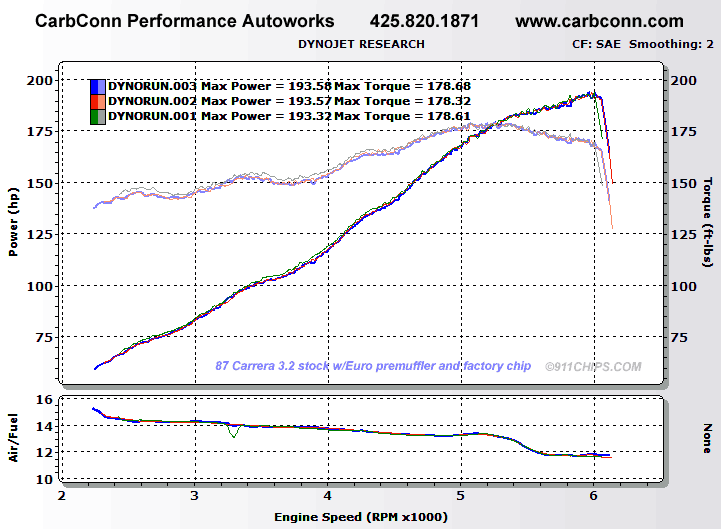
The
following chart represents the same 87 Carrera on
the same Dynojet dynamometer subsequent to installing
a European premuffler in place of the cat. The
chip has not been changed yet and is still factory.
Now that there is no cat to influence the CO output
the afr sensor, we can get a true reading of the
air/fuel ratios at full throttle. We can see that
the air fuel ratios are excessively lean throughout
the power curve, beginning at around 14.5:1 at 2500
rpm. and dropping to 13.3:1 at 5200 rpm. The mixture
from 5600 rpm on measures rich around 11.6:1, which
indicates the factory programmed the mixture above
5500 rpm excessively rich for the catalyzed versions
to keep the cat cells cool under sustained full
throttle high rpm operation. This may be fine for
the cat in Germany on the Autobahn at 150 mph, but
robs power for use anywhere else. As the owner
has effectively converted his exhaust to the European
configuration by the installation of the premuffler,
his flow has increased to the point where fuel optimization
is required to maximize his potential. At full
throttle, the Bosch Motronic DME ignores all sensor
inputs, including the air flow meter and O2 sensor,
and injects a preprogrammed amount of fuel and ignition
timing programmed for a stock motor. Therefore,
no matter what modifications you perform to your
motor to increase the airflow into it, your DME
will still inject the same amount fuel as for a
stock motor, and fuel=power. If our afrs become
too lean, we start to risk our motor with predetonation.
Likewise if the afrs are too rich, we loose power
by drowning the motor with excess fuel. Comparing
the two dyno runs, we can see that peak hp at 6000
has increased by an average of 7.5 rwhp, or approximately
8 flywheel hp. Factoring an assumed 15% drivetrain
loss, 193 rwhp works out to 227 flywheel hp, very
close the the factory rating of 231 hp for the European
version of the Carrera. However note that the power
curve between 2000 to 5200 has not changed all that
dramatically. This is because the DME has not been
reprogrammed to deliver the additional fuel required
as evidenced by the lean afr curve in that region.
The peak numbers have increased only because the
factory already preprogrammed the region from 5600
on up excessively rich here for predetonation protection.
Here, because of the excessive richness, it is possible
to derive additional horsepower by optimizing the
mixture,
The
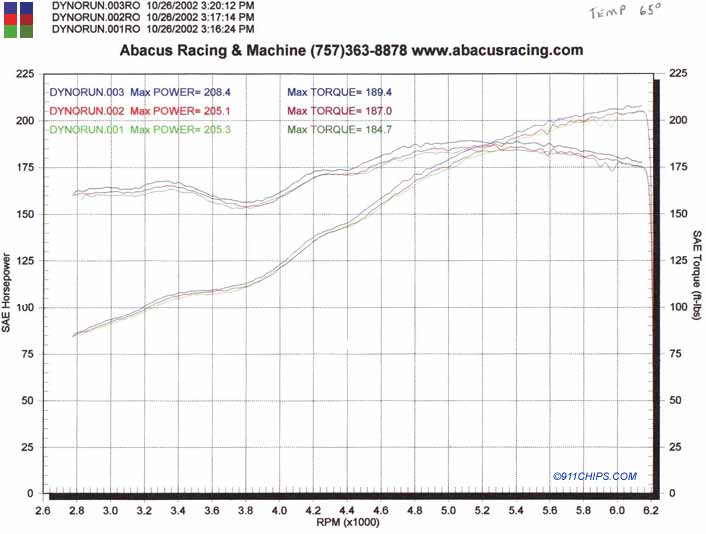
following dyno chart represents the horsepower and
torque attained from George M's' standard 911 '89
3.2 with the exception of the following modifications:
SSIs, Monty single out muffler, and a 911Chips performance chip
programmed for SSIs/headers and sport muffler.
Three runs were performed of the same configuration,
and again these figures represent rear wheel horsepower.
Factoring in an assumed 15% drivetrain loss, the
208 rwhp works out to 245 flywheel hp.
More
dyno runs to follow. Please come back as this site
will be updated frequently.
|